Logic puzzles
Sums, Lotus, Constellations, Nalou & Ziggy, Lanterns, Skyscrapers, 24, Animal Sudoku, Caterpillars, The Grumpy Gnomes, Hungry Tummies, Ice Floe, Cuddles.
Articles / AI & Puzzles
What I learned building a whole website of 21 logic and word puzzles by directing an AI like a development team, without writing the code myself.
· by Olivier Bouchez
I'm curious by nature. I wanted to find out how far an AI can go when you treat it like a development team: you bring the goal, the requirements and the quality bar, and it does the design, the drawing and the coding. So I built a whole website of logic and word games without writing the code myself.
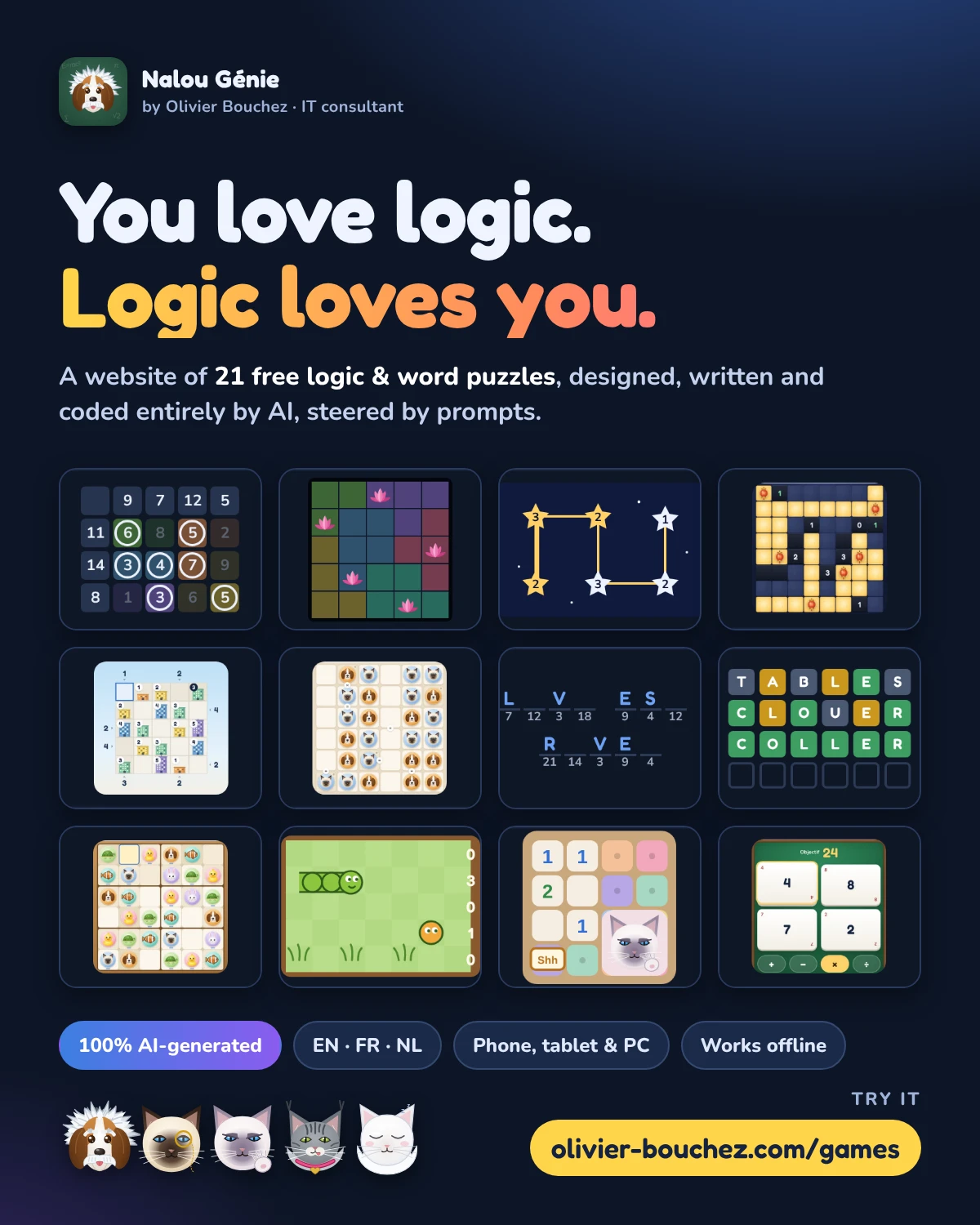
There are Sums, Lotus, Constellations, Skyscrapers, Cryptogram, Mystery Word, crosswords, mazes and more. A new grid is generated every time you play, and each logic grid has a single solution you can reach by pure deduction: no guessing required.
Sums, Lotus, Constellations, Nalou & Ziggy, Lanterns, Skyscrapers, 24, Animal Sudoku, Caterpillars, The Grumpy Gnomes, Hungry Tummies, Ice Floe, Cuddles.
Crossword, Mystery Word, Cryptogram.
Maze, Where's Nalou's Bone?, Hide and Seek, Operation Scyannah, Retro Tennis.
Everything is available in English, French and Dutch. It works on a phone, a tablet or a PC, it can be installed like an app, and it keeps working offline.
I wrote no code. The design, the code, the drawings, the puzzle generators and the translations into English, French and Dutch were all written by AI. Even the daily gazette starring Nalou, my beagle, and her four cat friends comes from AI.
My part was to steer it with prompts: say what I wanted, say what "done" looks like, and look at what came back.
The real lesson was how to specify and direct an AI through the complete design of an interactive website. In practice that came down to four habits.
It's the same discipline I use every day in data governance: define what "good" looks like, check it, and keep a human in the loop.
The same principle runs through my AI governance framework, which describes how I evaluate, classify and document AI applications.
On your phone, tablet or PC. You can install it like an app, and it works offline.
This article was drafted with Claude from my LinkedIn post and reviewed by me. See the disclaimer.